
What to Expect in a Schroth Treatment Session for Scoliosis
The Schroth Method is a research-backed, proven treatment to help children, teens, and adults with scoliosis. Schroth Therapy…


Get in touch with Rose
Rose McLean, PT, DPT, c/NDT, is co-owner and lead physical therapist at Chicago Pediatric Therapy & Wellness Center, where she has dedicated over 20 years to helping children with developmental challenges achieve their movement goals. Rose's specialized focus on pediatric physical therapy, combined with her commitment to multidisciplinary collaboration, has made her a trusted resource for families navigating motor delays, neurological conditions, and complex developmental needs throughout Chicago. Rose earned her Doctorate in Physical Therapy from Northwestern University in Chicago in 2004, where she received rigorous training in both pediatric and neurological rehabilitation. She began her clinical career at Cincinnati Children's Hospital, consistently ranked among America's top pediatric medical centers, where she gained invaluable experience treating children with diverse and medically complex conditions. This foundation shaped her evidence-based, child-centered approach to therapy. Beyond her doctoral training, Rose holds certification in Neurodevelopmental Treatment (NDT), a specialized intervention approach for children with cerebral palsy, neurological impairments, and other developmental disorders. She also maintains registration with Illinois' Early Intervention Program, allowing her to provide services to infants and toddlers (birth to age 3) in both home and clinic settings. Rose's therapeutic style is distinctively playful and highly individualized. She invests time in understanding each child's personality, interests, and motivators, then designs sessions that feel like play while targeting specific developmental goals. Whether working on strength, balance, coordination, or motor planning, Rose ensures therapy remains engaging and appropriately challenging. In 2014, Rose partnered with her husband Patrick to establish Chicago Pediatric Therapy & Wellness Center, driven by a vision that pediatric therapy should be comprehensive, collaborative, and convenient. She wanted to eliminate the fragmentation families often experience when their child needs multiple therapies—instead offering coordinated care where physical therapists, occupational therapists, speech-language pathologists, behavior analysts, and social workers communicate regularly about each child's progress. Rose also prioritized creating community spaces where families can connect and children can learn social skills alongside therapeutic development.
Read Less →A young child’s mission is primarily adjusting to their new world outside of their mothers’ wombs and understanding the new environment around them. They explore the environment through play. Isn’t that the most fun way to learn? You might notice how babies put things in their mouths as they learn about the properties of those objects, how the objects feel in their mouths, how they taste and smell, and so on. We learn about the physical properties of the world, oftentimes, by looking (or reading) and listening; babies use all of their senses and bodies to learn and understand how the world works! What a tall order for our little explorers! One way to support young children in their quest to owning their places in the world is enriching the atmosphere around them so that they are in the environment that is stimulating or conducive to active exploration. To do so, you can provide your children with playthings that they can explore.
If we look closely at how children progress developmentally, we notice that newborns and young babies are initially more interested in human faces and human interactions. Around five to seven months of age, they begin to pay attention to objects more and more and this new skill is coupled with their emerging ability to use their arms and hands to reach out voluntarily. As a result, you can make a baby’s environment stimulating by interacting with the younger ones positively and having face-to-face fun together. Through such interactions with you, they are learning the most important lessons about people. To illustrate, when they enjoy your presence and feel loved by you, they learn that people can be trusted and the world is a safe place to thrive. You are giving them what psychologists call an “internal working model” or a template for future relationships that is positive and loving. When they grow up and are able to bond with their teachers and fall in love with their partners, please feel proud of yourself because your early loving play with them has paved the way for them to have positive and healthy relationships in the future.
What does this type of person-to-person interaction look like? Think of singing Patty Cake together while you are encouraging your child to take turns singing or doing the hand movements. It is just you and your child playing together and delighting in each other… no toys. There is also a rhythm to this type of play. Perhaps, you start the interaction and then you pause for them to take their turn. They then pause to give you space for you to take your turn and continue the interaction. Through this interaction with you, not only does your child learn to focus their attention on you and imitate your actions, but they also learn to take turns and initiate fun games with you. This type of person-to-person play usually involves the songs that most of us know by heart such as the Itsy Bitsy Spider, Wheels on the Bus, Patty Cake, and so on. Alternatively, it could be the songs or rhymes that you invented when you change their diaper, feed them, or tuck them in. In short, it could be any songs or games that have the same words and structures every time they occur. Since you are likely to sing these songs with them several times a day, they will know the structure of the songs well – where to pause, what to say, which hand movements to use. So, it is a safe place to begin involving young children in their interactions with you. You are the best play partners your child could ever ask for.
The Hanen Center calls the type of person-to-person play that we discussed in the previous blog People Play. Below are some tips that we have tried and found to be effective when you encourage children to join you in play. This approach is called R.O.C.K. the People Play.
“R” stands for REPEAT what you do and say. Repeating what you do and say at the beginning of play cues your child to know that the game that they like and know well is about to begin. You will also be teaching them how to ask or initiate the game later on. If you say, “tickle, tickle” before you engage in a tickle game with them, stick with it. Try not to change it by saying something else, such as “Oh, I’m gonna tickle you.” The same principle applies to what you do and say during the game. This is because the more you repeat the same sequence of music, lyrics, and body movements, the more they will be confident in trying to imitate you and participate in the game later on. Repeating how you end the game either by saying, “Finished” or “All done” teaches them to use those words or signs in other situations so they have a way to tell you what they need without crying.
“O” stands for OFFER a child opportunities to take turns. Give them a chance to take the same turns, ideally every 5-10 seconds, at the same places every time you play together. For example, you can sing, “the Itsy Bitsy Spider went up the water spout. Down came the rain and washed the spider….” Then wait with an expectant and animated facial expression for them to take their turn. They may or may not say, “Out” or perform the “correct” hand movements. That is fine. Perfection is not the goal; interaction and fun are. Their turn can be a smile, eye contact, or even a kick with their feet. We encourage you to take any of these behaviors as intentional and meaningful.
“C” stands for CUE your child to take turns. There are many ways to prompt your child to take their turn. You can begin prompting by being very hands on so that they only make little mistakes and do not get discouraged. One technique is hand-under-hand. You place your hand under theirs to guide the hand movements. When you want them to repeat parts of the game verbally, you can say, “Say, ‘Out.’” As they improve at taking turns, there is no need for you to be as hands on as earlier. What you can try is giving them nonverbal hints instead by pausing while looking at them expectantly. Once you try this cueing, you will know which cues are and are not intrusive and which cues makes them feel that they have your support.
“K” stands for Keep it fun! Keep it going! Your body language and facial expressions are key to convey how much fun you are having. Keep the energy level up as it tends to keep your child engaged. You can choose games that offer them big movements if they like them. For instance, you might want to try swinging game, horsey ride, chase game, or jumping game (perhaps, on top of a pile of pillows). If they like feeling pressure on their body, you could try touch and squeeze games. The bottom line is keeping the game fun while respecting their sensory preferences. It’s as easy as A, B, Cs, right? Simply by adding a little structure to the games you already play with your child, you become more effective at teaching them how to master the People Play with you.
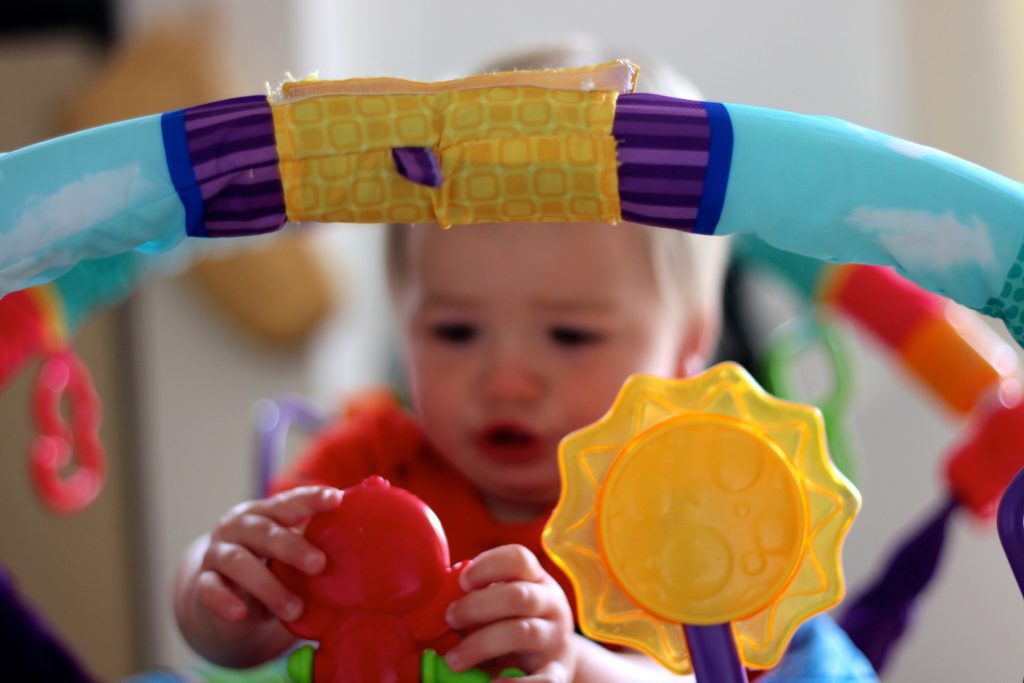
Apart from your daily loving interactions and People Play with your child, toys, objects, and playthings could serve to enrich the environment where your child is. Selecting great toys for your children will be the focus of this article. Toys in this case mean any objects that children can use their bodies and senses to explore. They should be able to put toys in their mouths, bang them, stack them, listen to the sounds from the objects, and so on. Remember, young children learn through senses, bodies, and physical manipulations of the objects. Additionally, toys can be anything from empty cardboard boxes and other homemade playthings to bubbles and dolls.
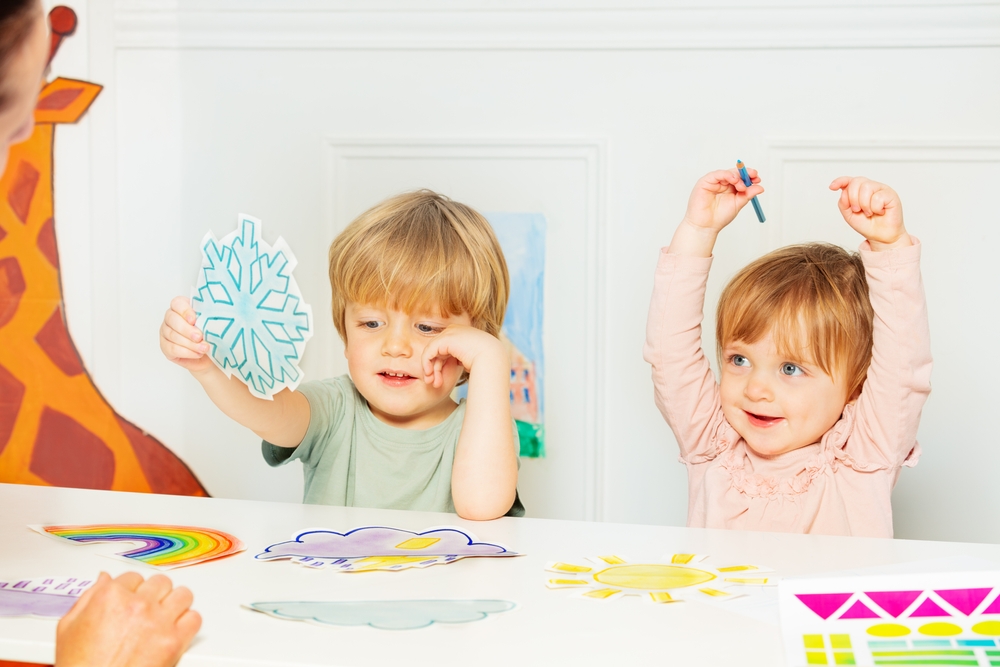
When parents ask which toys or brands of toys to buy for their children, one rule of thumb that for parents to follow is to look at where their children are developmentally. What can they do with their hands and arms? Can they reach out to bat at objects? Then, a colorful mobile might entice them to keep practicing reaching out to try to touch it. Or, when your toddlers are beginning to act out the way they cook with you or how you tuck them in, it might be a good time to get them a doll house, a doll, a kitchen set, or a set of toy foods for them to practice this new stage of play called pretend play. Better yet, make some of those items at home from recycling materials. It’s a wonderful way to get creative with your children and make toys at home to involve them a family activity. Below are general guidelines for which toys are appropriate for children in certain age ranges. Remember that each child has a unique pace of development; as a result, please use the below age ranges only as guidelines. Try selecting toys outside of your child’s age range in order to mix and match the toys and make them work for your child. Variety and novelty are going to make toys even more fun!
0-6 months
6-12 months
1-2 years
3-5 years
References
http://www.naeyc.org/toys
http://eiclearinghouse.org/resources/videos/toys.html
http://www.zerotothree.org/child-development/play/tips-for-choosing-toys-for.html
Take the first step towards supporting your child's development.
Rose McLean
 Cara Lucas
 Melina Segneri
Our expert team is here to help. Schedule a consultation today.