


The following page details strategies that parents can use at home to facilitate language and encourage communication with their child from birth through age three. These strategies are designed to help children meet their developmental language milestones.
From Birth-1 year:
It is important to reinforce your baby’s communication attempts by looking at him or her, speaking, and imitating his or her vocalizations. When your baby coos or babbles, coo or babble right back! Your baby will start stringing sounds together and (i.e., “mama, dada”). Imitation will encourage your child to initiate communication due to your reinforcement of his or her beginning steps of language development. It is also important to imitate your baby’s facial expressions and laughter in order to develop reciprocation. Have your baby imitate actions (i.e., peek—a-boo, pattycake) in order to teach reciprocation and turn-taking. You can also learn to comment on activities that you are doing so that your baby can hear language development such as playing, grooming, eating (i.e., “You’re brushing your teeth!” “The doll is wearing a dress” “The cow says ‘moo.”)
From 1-2 years:
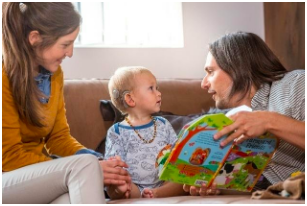
It is important to continue to comment on what is happening in the environment or what the child is doing. You can expand on the language that you are already using (i.e., “The cow says moo. The cow is big and brown”). Find books that are motivating to your child and read with your child not to your child. Allow your child to comment on the pictures he or she sees in the book and continue to comment yourself (i.e., “horse” “the horse is brown”). Have your child imitate sounds. Have your child continue to label pictures and items. By age two, your child may have a repertoire of 10-20 words, so continue to use those words in your vocabulary as well. Your baby may be exploring his or her body, so work on labeling those body parts and having her/him follow directions to find those body parts (i.e., “Touch your head!”).
From 2-3 years:
Continue to comment on what your child is seeing or doing and continue to use words that are easy for your child to imitate. Encourage your child to use words to describe something that they want. For example, if your child wants a stuffed animal you can say, “I know you want a stuffed animal. Tell me again which animal that you want.” Continue to promote talking about colors (i.e., “I see a cat. The cat is black”). You can also practice counting with your child. You can count essentially anything: You can count blocks, fingers, toes, raisins, anything! Continue to expand on utterance length during these times (i.e., “You have 4 red blocks!”) You can begin to works on labeling and naming actions. For example, when looking at a book, you can comment on what the person or animal is doing (i.e., “The boy is swimming in the pool”). While the ability to answer yes or no is an important skill for you child, continue to allow your child to make choices to expand on verbal language and the skill of choice making (i.e., “Do you want to eat the cookie or drink the juice?”). This allows your child to use more language to answer a question, rather than a quick “yes” or “no.” You can also work on receptive language by having your child work on following multi-step directions and spatial concepts (i.e., “Put your doll on the table and get your hat”).
If you still have concerns about your toddler’s speech development, contact our office today for an assessment to determine if there are other, more specific interventions to help your child. Our pediatric speech specialists can be reached at 773-687-9241