
Generalization in ABA Therapy: How Lakeview Kids Learn to Use New Skills in Real Life
Important Note for Families: This information is for educational purposes only and does not constitute medical advice, diagnosis,…
Get in touch with Melissa
Melissa Menendez, M.S., CCC-SLP, CLC, is a licensed speech-language pathologist and Certified Lactation Consultant who brings a unique combination of expertise to Chicago Pediatric Therapy & Wellness Center. As clinical lead for the speech-language pathology team, Melissa ensures high-quality, family-centered care while maintaining an active caseload that spans infancy through early childhood. Her dual credentials in speech pathology and lactation consulting provide a seamless continuum of support for families from a baby's first feeding through their emerging communication skills. Melissa's academic foundation began at the University of Illinois Urbana-Champaign, where she earned a Bachelor of Science in Speech and Hearing Science in 2011. This rigorous program provided early exposure to communication disorders, audiological sciences, and child development. She continued her training at Illinois State University, earning her Master of Science in Speech-Language Pathology in 2016, followed by her Clinical Fellowship Year and ASHA certification. Recognizing the critical intersection of feeding and communication development, Melissa pursued additional training to become a Certified Lactation Consultant (CLC), expanding her ability to support families from birth onward. Since joining Chicago Pediatric Therapy & Wellness Center in 2021, Melissa has developed expertise across multiple specialty areas. Her clinical practice includes early language development, supporting children from babbling and first words through complex sentences and conversational skills; infant feeding and lactation support, addressing breastfeeding challenges, bottle-feeding concerns, and oral motor development from birth; transitioning to solid foods, helping families navigate baby-led weaning, texture progression, and oral sensory exploration; managing picky eating and food refusal, using evidence-based strategies to expand dietary variety; articulation therapy, targeting speech sound production including notoriously difficult sounds like /r/; and augmentative and alternative communication (AAC), supporting children who benefit from communication devices and visual supports to express themselves. In her leadership role as clinical lead, Melissa fosters a culture of continuous learning, facilitates regular case discussions, ensures evidence-based practice standards, promotes collaboration with occupational therapists, physical therapists, and behavior analysts, and provides mentorship to newer clinicians. She is passionate about empowering families through education and partnership, recognizing that parents are their child's most important communication partners. Melissa creates individualized therapy plans that respect each family's values and work across home, school, and community environments.
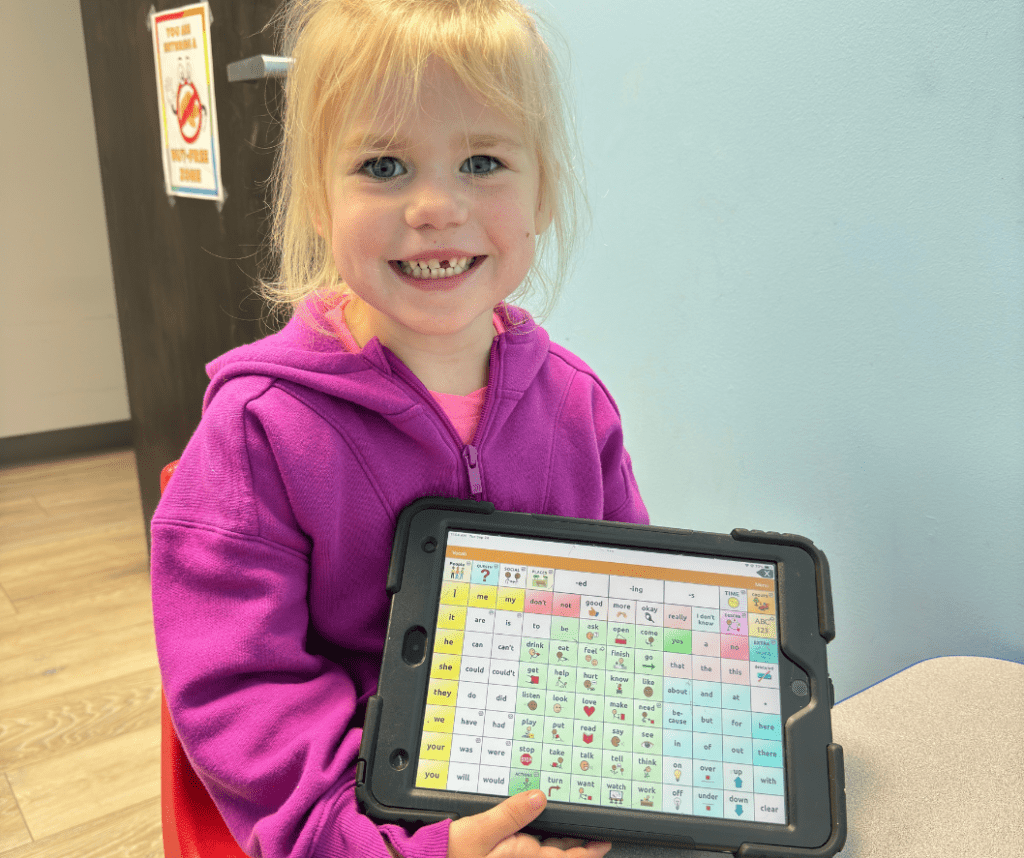
Read Less →October is AAC awareness month! You might be thinking, “I’ve heard the term AAC used often, but what is it?” Let’s break it down and teach you the AAC Basics for you.
Augmentative and alternative communication (AAC) is an umbrella term that encompasses the communication methods used to supplement or replace speech or writing for those with impairments in the production or comprehension of spoken or written language.


Research shows the use of AAC can enhance speech production, or that it would remain the same, but it would never hinder it. AAC use can lead to great strides in speech development. One technique that has proved very helpful when paired with an AAC device is Aided Language Stimulation. This is a language stimulation approach in which the facilitator uses the client’s communication system and repeats it with their verbal language (i.e., communicating with the client using their symbols as much as we talk to them using verbal language).
This method along with many others are practiced here at our clinic and many others across the country. If you have more questions about AAC Basics or about receiving more help with getting your child to reach new speech milestones, please give us a call at 777-687-9241 or check out our Speech Therapy Page.
Take the first step towards supporting your child's development.
Jenna Hultgren

 Cara Lucas
 Nathalie Deutsch
Our expert team is here to help. Schedule a consultation today.