

Bottom scooting – or shuffling – is a way that many children use when first learning how to explore their environment. Even though it is effective, this position can exacerbate muscle weakness and asymmetry. Therefore a means of mobility that we want to discourage.
What is Bottom Scooting?
Bottom scooting is when a child sits on their bottom, typically with one leg bent and one leg straight. They will have one hand on the ground (usually the hand of the side where the leg is bent). For example, your child may sit with their left leg straight out to the side, right leg bent at the knee and right hand on the ground. In this case the child would propel themselves forwards by shifting their weight onto their right arm. Then lifting their body weight forwards. A few repetitions of this and they are quickly under the table or out the door in a flash!

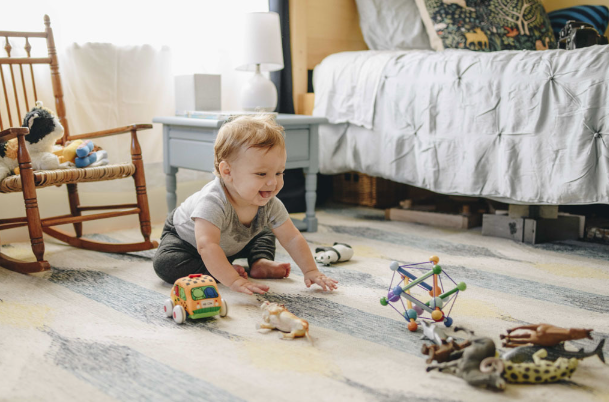
Initially this seems great – the child is up and moving and now can access all their toys independently. Though independent movement is essential for kids to develop proprioception and object permanence, in this case we want quality of movement to outweigh quantity of movement.
Why Bottom Scooting Does Not Enhance Development
There are several reasons why bottom scooting does not enhance gross motor development.
- Children will asymmetrically weight bear on their arms – the arm that is propelling their body forwards will be the same the majority of the time. This can cause the opposite arm to have fewer repetitions of weightbearing, which can lead to muscle weakness in that arm.
- Children who bottom scoot will demonstrate asymmetrical weightbearing on their hips. The hip of the side of the leg that is bent will take the majority of the weight. This can lead to muscle asymmetry in the trunk and hip musculature.
- There is no need for trunk rotation when bottom scooting. Trunk rotation can be a tricky skill for children when upright – it forces you to use your abdominal obliques as well as balance your trunk flexors and extensors. When butt scooting, there is no need for trunk rotation.
- Bottom scooting does not require a child to transition from sitting to all-4’s over their hips. This lack of transition does not give the abdominals or outer hip musculature a chance to strengthen.
Warning Signs to Look For
Many people ask when they should be concerned about bottom scooting. If the bottom scooting is the primary means of mobility or is becoming increasingly used, then you should seek out medical advice from your pediatrician or a physical therapist. If your child seems to be in pain when they attempt to transition from sitting to all-4’s or standing, or if they seem to be pain when you place them in quadruped, then consult your pediatrician because there could be an underlying orthopedic issue. Lastly, if your child had/has torticollis, then this position will exacerbate their torticollis symptoms and your child should begin treatment with or continue seeing a physical therapist.

Ways to Help at Home
There are some easy ways to facilitate your child from bottom scooting to all-4’s at home.
- Have your child try to crawl over your leg, large pillows or put the couch cushions on the ground. Once there, have him/her try to crawl over them. It is very difficult to bottom scoot over an object, so building little obstacle courses at home will force your child to transition to quadruped.
- Place your child in an all-4’s position with an interesting toy in front of them. Help them to maintain this position by holding both of their hips and slowly rocking them forwards and back so that they can get used to holding up their weight with both arms.
- Practice transitions over their hip. Start with your child sitting and place a toy far to their left. Assist your child in obtaining the toy by placing their left arm on the floor and bringing their right arm across their body and to the floor. To complete this, they will have to transition to all-4’s.
- Typically children who bottom scoot have some weakness in their hip or abdominal musculature. Help them to strengthen symmetrically by working on climbing activities, such as climbing up small steps when on all-4’s or up play structures at the park.
Children are at a fast pace of learning when they finally become mobile! Movement is exciting for all involved, but we want to make sure your child is not “practicing” poor movement patterns. Especially not all day long! Remember, symmetrical crawling now means symmetrical walking later! If you see any of these atypical forms of crawling, please call the specialists at our clinic for a physical therapy assessment. We will help get your little one back on track! We can be reached at 773-687-9241 or info@cptwc.com. Happy crawling!