
How to Get Your Child Jumping
Walking, running and jumping are the building blocks to gross motor play. Most children learn to jump approximately…



Get in touch with Rose
Rose McLean, PT, DPT, c/NDT, is co-owner and lead physical therapist at Chicago Pediatric Therapy & Wellness Center, where she has dedicated over 20 years to helping children with developmental challenges achieve their movement goals. Rose's specialized focus on pediatric physical therapy, combined with her commitment to multidisciplinary collaboration, has made her a trusted resource for families navigating motor delays, neurological conditions, and complex developmental needs throughout Chicago. Rose earned her Doctorate in Physical Therapy from Northwestern University in Chicago in 2004, where she received rigorous training in both pediatric and neurological rehabilitation. She began her clinical career at Cincinnati Children's Hospital, consistently ranked among America's top pediatric medical centers, where she gained invaluable experience treating children with diverse and medically complex conditions. This foundation shaped her evidence-based, child-centered approach to therapy. Beyond her doctoral training, Rose holds certification in Neurodevelopmental Treatment (NDT), a specialized intervention approach for children with cerebral palsy, neurological impairments, and other developmental disorders. She also maintains registration with Illinois' Early Intervention Program, allowing her to provide services to infants and toddlers (birth to age 3) in both home and clinic settings. Rose's therapeutic style is distinctively playful and highly individualized. She invests time in understanding each child's personality, interests, and motivators, then designs sessions that feel like play while targeting specific developmental goals. Whether working on strength, balance, coordination, or motor planning, Rose ensures therapy remains engaging and appropriately challenging. In 2014, Rose partnered with her husband Patrick to establish Chicago Pediatric Therapy & Wellness Center, driven by a vision that pediatric therapy should be comprehensive, collaborative, and convenient. She wanted to eliminate the fragmentation families often experience when their child needs multiple therapies—instead offering coordinated care where physical therapists, occupational therapists, speech-language pathologists, behavior analysts, and social workers communicate regularly about each child's progress. Rose also prioritized creating community spaces where families can connect and children can learn social skills alongside therapeutic development.
Read Less →Bottom scooting – or shuffling – is a way that many children use when first learning how to explore their environment. Even though it is effective, this position can exacerbate muscle weakness and asymmetry. Therefore a means of mobility that we want to discourage.
Bottom scooting is when a child sits on their bottom, typically with one leg bent and one leg straight. They will have one hand on the ground (usually the hand of the side where the leg is bent). For example, your child may sit with their left leg straight out to the side, right leg bent at the knee and right hand on the ground. In this case the child would propel themselves forwards by shifting their weight onto their right arm. Then lifting their body weight forwards. A few repetitions of this and they are quickly under the table or out the door in a flash!

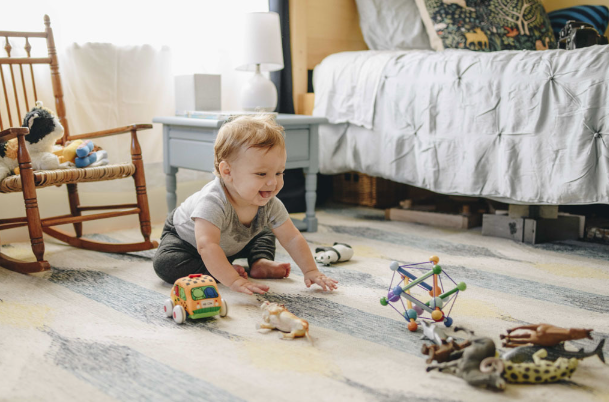
Initially this seems great. The child is up and moving and now can access all their toys independently. Though independent movement is essential for kids to develop proprioception and object permanence, in this case we want quality of movement to outweigh quantity of movement. Gear can limit movement too. A separate post weighs the trend toward weighted sleep suits and what they mean for a baby’s freedom to move.
There are several reasons why bottom scooting does not enhance gross motor development.
Many people ask when they should be concerned about bottom scooting. If the bottom scooting is the primary means of mobility or is becoming increasingly used, then you should seek out medical advice from your pediatrician or a physical therapist. If your child seems to be in pain when they attempt to transition from sitting to all-4’s or standing, or if they seem to be pain when you place them in quadruped, then consult your pediatrician because there could be an underlying orthopedic issue. Lastly, if your child had/has torticollis, then this position will exacerbate their torticollis symptoms and your child should begin treatment with or continue seeing a physical therapist.

There are some easy ways to facilitate your child from bottom scooting to all-4’s at home.
Children are at a fast pace of learning when they finally become mobile! Movement is exciting for all involved, but we want to make sure your child is not “practicing” poor movement patterns. Especially not all day long! Remember, symmetrical crawling now means symmetrical walking later! If you see any of these atypical forms of crawling, please call the specialists at our clinic for a physical therapy assessment. We will help get your little one back on track! We can be reached at 773-687-9241 or info@cptwc.com. Happy crawling!

Take the first step towards supporting your child's development.
Patrick McLean
Owner
 Patrick McLean
Owner
Patrick McLean
Owner
 Rose McLean
Our expert team is here to help. Schedule a consultation today.