
Generalization in ABA Therapy: How Lakeview Kids Learn to Use New Skills in Real Life
Important Note for Families: This information is for educational purposes only and does not constitute medical advice, diagnosis,…




Get in touch with Cara
Cara Lucas, MS, BCBA, serves as Director of Applied Behavior Analysis at Chicago Pediatric Therapy & Wellness Center, where she has built and led a comprehensive ABA program since 2018. With over seven years of clinical leadership and 13+ years of experience in the field, Cara combines clinical expertise, staff development, and genuine family partnership to create an ABA program that prioritizes meaningful growth and joy alongside evidence-based outcomes. Cara's educational journey began at Butler University, where she earned a Bachelor of Arts in Psychology in 2012. This foundation in human behavior, development, and research methods prepared her for specialized training in applied behavior analysis. She continued at Southern Illinois University, earning a Master's degree in Rehabilitation and Behavior Analysis in 2017, followed by supervised fieldwork hours and successful completion of the Board Certified Behavior Analyst (BCBA) examination. In her role as ABA Clinical Director, Cara manages multiple critical functions: program development and quality assurance, direct supervision of BCBAs and Registered Behavior Technicians (RBTs), family consultation and parent training, interdisciplinary collaboration with speech, occupational, and physical therapists, and staff development and clinical mentorship. Her leadership philosophy centers on compassionate, customized, and collaborative support—she believes that effective ABA helps children grow with joy, purpose, and connection rather than focusing narrowly on behavior reduction. Cara has developed specialized expertise in two complementary areas. First, she champions Organizational Behavior Management (OBM) strategies—applying behavior analysis principles to organizational systems to enhance staff performance, improve clinical effectiveness, and support team member well-being. Second, she is passionate about Acceptance and Commitment Therapy (ACT), an evidence-based approach that fosters psychological flexibility, values-aligned behavior, and meaningful change. Her ACT training informs both her clinical work with children and her coaching approach with families. Cara provides services to individuals ages 2 through 21, with strong emphasis on developmental appropriateness. She recognizes that effective interventions look different at age 3 versus age 13 versus age 19, and she tailors her approach accordingly. Cara values collaborative partnerships with parents and caregivers, offering training and support that empowers families and ensures skills generalize across home, school, and community settings. Her vision for ABA is one where every child's unique strengths are celebrated and every family feels supported on their journey.
Read Less →Playing is a foundational skill that children begin to engage in at birth. Babies begin to engage in play by exploring the way their body moves. They also engage with toys that are placed in front of them. As children develop their play skills, these skills begin to expand and build based off their age.
Children on the autism spectrum can at times struggle with the development of play, and resort to isolation or playing by themselves. This often occurs because of difficulties that children on the spectrum have with understanding how to play, or reading social cues from other peers during cooperative play. Seeking ABA (Applied Behavior Analysis) as a resource to help your child develop these skills is the first step to begin to build the ideas and concepts around play.
There are definitely many misconceptions that parents have when looking to start ABA services. A primary misconception is that their child needs to possess certain foundational skills in their ability to play in order for ABA to be successful. Luckily, this is not true at all. As experts in the field, and as an extremely play based Center, we know that sometimes play is a skill that will need to be taught.
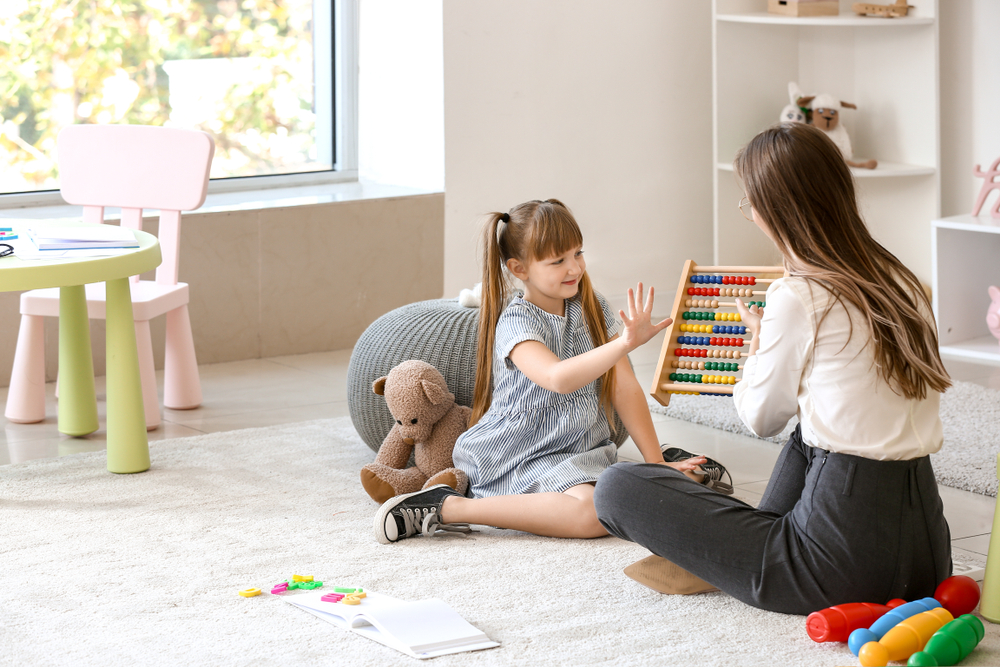
During an initial assessment for ABA, play is a domain th at is heavily focused on. When assessing, the therapist will observe the child’s social interactions with others. They will study play functions (i.e. parallel play, cooperative play, or solitary play), and their ability to adapt to social changes within their environment. Based off of these findings, a treatment plan is created. They will do 1:1 therapy as well as group therapy with an RBT (Registered Behavior Technician), who helps to teach and facilitate play, will begin.
Then comes the fun part! The therapists on every child’s team are able to teach each child how to play, based on understanding what motivates them as well as how they learn. The RBT’s will contrive an environment that fosters play for each child.

They work on parallel play, interactive play, independent play, and how to appropriately approach peers to build relationships. Another core piece of teaching a child how to play, is giving each parent the tools to help them be successful. Here are a few tips that can help with fostering play with children on the spectrum:
Play is an essential part of childhood. If your child would benefit from ABA, know that play is heavily incorporated into each and every child’s care plan and intervention strategies, in order to engage fully with each child! Also, it helps motivate them to learn and most of all HAVE FUN!
The pediatric specialists at Chicago Pediatric Therapy & Wellness Center love helping kids play every day. We would be thrilled to help your child develop their play skills through behavior therapy. For more information, check out our ABA Therapy Page! To schedule your assessment or sessions at our Center, call our office today at 773-687-9241!
Take the first step towards supporting your child's development.
Jenna Hultgren
 Cara Lucas
 Nathalie Deutsch
Our expert team is here to help. Schedule a consultation today.