Generalization in ABA Therapy: How Lakeview Kids Learn to Use New Skills in Real Life
Important Note for Families: This information is for educational purposes only and does not constitute medical advice, diagnosis,…


Get in touch with Melissa
Melissa Menendez, M.S., CCC-SLP, CLC, is a licensed speech-language pathologist and Certified Lactation Consultant who brings a unique combination of expertise to Chicago Pediatric Therapy & Wellness Center. As clinical lead for the speech-language pathology team, Melissa ensures high-quality, family-centered care while maintaining an active caseload that spans infancy through early childhood. Her dual credentials in speech pathology and lactation consulting provide a seamless continuum of support for families from a baby's first feeding through their emerging communication skills. Melissa's academic foundation began at the University of Illinois Urbana-Champaign, where she earned a Bachelor of Science in Speech and Hearing Science in 2011. This rigorous program provided early exposure to communication disorders, audiological sciences, and child development. She continued her training at Illinois State University, earning her Master of Science in Speech-Language Pathology in 2016, followed by her Clinical Fellowship Year and ASHA certification. Recognizing the critical intersection of feeding and communication development, Melissa pursued additional training to become a Certified Lactation Consultant (CLC), expanding her ability to support families from birth onward. Since joining Chicago Pediatric Therapy & Wellness Center in 2021, Melissa has developed expertise across multiple specialty areas. Her clinical practice includes early language development, supporting children from babbling and first words through complex sentences and conversational skills; infant feeding and lactation support, addressing breastfeeding challenges, bottle-feeding concerns, and oral motor development from birth; transitioning to solid foods, helping families navigate baby-led weaning, texture progression, and oral sensory exploration; managing picky eating and food refusal, using evidence-based strategies to expand dietary variety; articulation therapy, targeting speech sound production including notoriously difficult sounds like /r/; and augmentative and alternative communication (AAC), supporting children who benefit from communication devices and visual supports to express themselves. In her leadership role as clinical lead, Melissa fosters a culture of continuous learning, facilitates regular case discussions, ensures evidence-based practice standards, promotes collaboration with occupational therapists, physical therapists, and behavior analysts, and provides mentorship to newer clinicians. She is passionate about empowering families through education and partnership, recognizing that parents are their child's most important communication partners. Melissa creates individualized therapy plans that respect each family's values and work across home, school, and community environments.
Read Less →My Child Has A Communication Device, Now What? You have gone through the steps of getting your child fit with the perfect augmentative and alternative communication or AAC device. That is amazing! You have opened up a new world of communication opportunities for your child and the possibilities are endless.
If you are looking at your child’s communication device and thinking, how in the world does this thing work? How can I help my child learn to use it? How can I make this technology a part of our daily lives? You are not alone! Supporting your AAC user can seem like an overwhelming task, so let’s break it down.
Here are 3 important steps for getting started.
All devices are organized differently. Once you get the hang of how the vocabulary is set up and how the pages are organized, things will become a lot easier. Take some time to play around with your child’s device. Press buttons and see where they lead, navigate back to the home page or even try having a conversation with someone using the device.
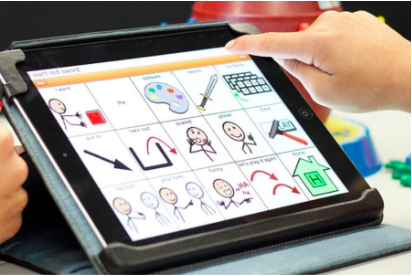
Find 3 words in the following categoriesGet to know the home screen: The main page or home screen typically consists of CORE vocabulary or high frequency words that we use often when communicating. These words hold a lot of power! Learn them, practice using them and model, model, model them for your AAC user.
Here are examples of 1 and 2-word combinations using CORE vocabulary:
Exploring the device, learning the layout, navigating through pages are important places to start. After that, combining words and using the device consistently is important and requires a lot of time and practice! Be patient with yourself and your AAC user. Try exploring while your AAC user is not around, so that you can learn and model faster while getting to know the device.
Now that you are more familiar with how the device works, start modeling language for your AAC user on his or her device. Just like verbal communicators learn to talk by being spoken to, AAC users need to see their device being used in order to learn how to use it.
Start by modeling just one key word at a time. You do not need to model every word that you say! For example, you might say, “Come to the table, it’s time to eat” while modeling “eat” or “come” on the device. Remember, a young child does not start out speaking in full sentences. They use one, then two, then multiple words at a time. Even though your child understands multiple words/sentences right now, they are essentially learning the new language of using an AAC device. Help them realize it’s ok to use a few words at a time. More importantly, that YOU understand what they are saying.
Embed modeling in your everyday routines. No need to set aside “AAC” time. Instead, pick 1 or 2 activities you already do everyday. Try modeling language with AAC during a meal, brushing teeth, playing a game, reading a book or greeting a family member.
This seems like a no-brainer, but if the device is new, it might take some time to get into the habit of making sure it is charged and with your AAC user at all times. Even if they are not using the device frequently or consistently yet, they still need access to their words all day, everyday! Above all, AAC will not stick if the device is only taken out during speech therapy. Set reminders and don’t forget to always have a charger handy!
In conclusion, the most exciting part about utilizing an AAC device is that your child will feel so empowered to have their thoughts and ideas understood. This is a new and amazing time for them!
Enjoy the process of helping with this growth and remember that the more practice and exposure you provide, the more words, thoughts and ideas you will be able to hear your child say. For more help utilizing and expanding on an augmentative communication system, or for a comprehensive AAC device assessment, please contact our speech pathologists at 773-687-9241 to schedule a session.
Many children using AAC devices also benefit from ABA therapy at our Chicago clinic, which reinforces communication goals through structured, consistent practice.
Take the first step towards supporting your child's development.
Jenna Hultgren

 Cara Lucas
 Nathalie Deutsch
Our expert team is here to help. Schedule a consultation today.